The Magic Encyclopedia ™ DataBase
The {ncompactr} hypercube
(by Aale de Winkel)
The qualifier {ncompactr} extents {ncompact} by mentioning the order (r) of the subhypercubes tested to have the same sum for the 2n corners. 'r' default to 2 recovering the qualifiers original meaning on order 2 subhypercubes. The progression of compactness turns out to be in any direction independent of the other direction, thus explains the notation {ncompact[jr]} to indicate the position the progression reached thus means that an entire range of "subhyperbeams" is connected with the initiated compactness qualifier.
In a discussion with <Dwane Campbell> who had investigated the feature in more detail, I learned that the compactness progression is lineair in nature, wherewith I mean that the progression along one direction doesn't depend on the progression in the other directions. The first table intents to reflect this.
| {compact} | ||||
|---|---|---|---|---|
|
the {compact} qualifier was originally defined on doubly even order (m=4k) squares to signify that every 2*2 subsquares have equal sums here the notion is expanded to corners of order r subhypercubes of any dimension and just a bit further to subhyperbeam corners that are specified by their respective relative position note: it is possible to define compactness on lower dimensional objects | ||||
| {ncompactr;r>=2} | the 2n corners of all n dimensional order r subhypercubes have equal sums | |||
| {ncompact[jr]} |
the 2n corners (specified by "relative position" [jr]) of all n dimensional subhyperbeams sum equally |
{compact}ness progression formula | ||
| {ncompactr;r>=2} => {ncompact[j(2k-1)(r-1)+1];r>=2;jk>=1 } | ||||
|
suppose: 1compactr and a b c d e f all r-1 apart, then S = a+b = b+c = c+d = d+e = e+f then a+d = (a+b)+(c+d)-(b+c) = S so 1compactr => 1compact3(r-1)+1 further a+f = (a+b)+(c+d)+(e+f)-(b+c)-(c+d) = S thus: 1compactr => 1compact5(r-1)+1 continuing this gives: 1compactr => 1compact(2k-1)(r-1)+1 this shows the progression along a single directions, easily seen that the directions are independent in this by simply adding corners in all the perpendicular directions together. |
||||
|
This proof shows that compactness propagates independently in all directions. Also if for some k: [(2k-1)(r-1)+1] % m = s the object is {1compacts} {1compactr} and {1compacts} can exist whether or not the other is present iff [(2k-1)(r-1)+1] % m != s for all k >= 1 or m - ([(2k-1)(r-1)+1] % m) + 2 != s for all k >= 1 |
||||
<Dwane Campbell> sent me order 16 square with various combinations of compactness. While order 8 cubes seem all to be {compact_2,3,5}.
Another generalisation of the original {compact} conciders patterns aside from the corners. This "pattern-compactness" will be investigated at some future date and various versions of {ncompact(pattern)r} discussed.
currently in flyby "solid" (all cells added) and '+' (corners, center, and ribmidpoint) of various sizes where mentioned.
One needs to be carefull to call a feature special or extra since they might be caused by more basic features, relations that might be formulated by some version of:
{compact(patternA)} => {compact(patternB)}
| pattern compactness | ||||
|---|---|---|---|---|
| {ncompact(pattern)r} |
an n dimensional pattern sums equally at every position pattern specified in hypercube of order r |
|||
| {ncompact(pattern)[jr]} |
an n dimensional pattern sums equally at every position pattern specified in hyperbeam specified by "relative position" [jr] (note: no experience with this yet) |
|||
|
{ncompactXnr} = {ncompact(Xn)r} |
<Dwane Campbell>'s abbreviation of patterncompactnes where the Xn numbers are equidistantially and summed over to the same sum (note: experience with this by Dwane) |
|||
| {ncompact(x0..xn-1)r} |
simular to Dwane's pattern but with various amounts of numbers along the directions (note: no experience with this yet) |
|||
|
Though this possibility is in it's infancy, it must be noted to be cautious in calling patterns extra features given patterns might be present due to a more basic underlying feature, reckognizing this feature is decent qualification practice. (see the {compact} square ABC defined further on present in every {compact} square) |
||||
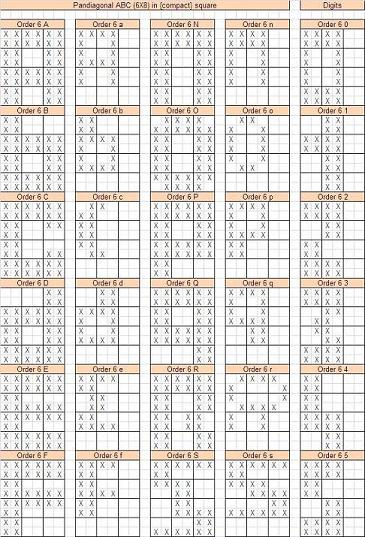
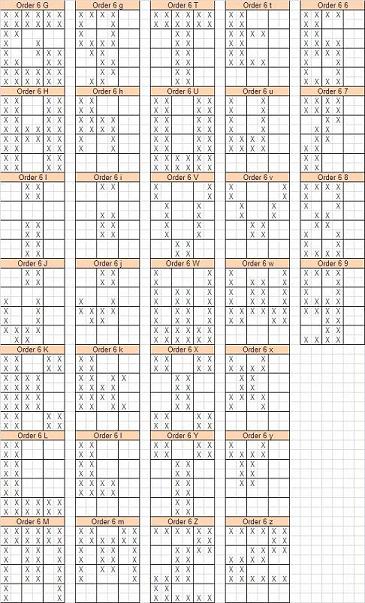
The above formulated impact pattern search in hypercubes since many a pattern follows from {ncompact2} below I formulated some letters which are {pandiagonal}ly present in {2compact2} squares, the reader might define himself {pandiagonal}chess in I reckon an order 32 square (feel free to send me the extra-rules (hi hi))
in a {3compact2} cube I trust one can define soccer- / foot-ball's. This excercise shows that stipulating such patterns as "extra feature" is redundant when the pattern derive from more basic qualities. Also the notes above show more complicated relations can be derived from basic qualifiers.
| {compact} Square ABC | ||||
|---|---|---|---|---|
| {2compact2} => {2compact(compactABC)[6,8]} | ||||
|
As a consequence of the forementioned theorem I constructed the alphabet on the side which is present in every {compact} square in a {pandiagonal} manner. Thus testing a square for the {compact} qualifier is sufficient to make certain that the that pattern on the left and many more patterns are {pandiagonal}ly present in the square Note. This set of letters is not the only possibility! It simply demonstrates that many patterns seen in a {compact} magic square is a consequence of {compact}ness, and not an extra feature in the square Construction notes: I confined the kapitals to the 6 by 8 block's For the lowercase I tried to define them in 4 by 6 but failed here to do this for the 's' and 'z', the 'g' needed a bit more hight while the k needed to borrow two cell's on the right 4 by 6 'v' looks too much like 'y' and thus broadened 'm' and 'w' needed the width for more natural reasons the 'r' looked too much like an 'a' alternative so I expanded the cirkel's width. Thus 'r' suggests alternate versions of 'b','d'.'p' and 'q' as also order 4 corners can be subtracted from the current version as well as the mentioned 'a'-circle 'e' and 'f' can turn their rows of 4 to rows of 2 like the mentioned 'c' which could have rows of 4 As said: lots of alternatives possible for other sizes look at the ancient dot-matrix printer fonts Figures with odd dimensions might be an extra feature, I see no way to construct a 5 by 5 "O-figure" based merely on {compact}ness! Every even by even "O-figure" are covered by the formulated theorem, same can be said for other figures as well. Save a possible typo the letters and digits on the left I tested by my programs pattern- tester, to be {pandiagonal}ly present in {compact} squares The above mentioned alternatives I haven't defined yet in the programs "pattern-file" |
|||
|
MAIN PURPOSE of this excercise is to show that viewing a feature as an extra might be an error you can read Shakespeare in a {compact} square if you want to do it. Doing thus in a {non-compact} square or odd-based letters might be an extra feature, or an indication of some other more basic feature. This feature is the one that one needs to search for in such a square! |
||||